Monday, March 3, 2014

How Wolves Change Rivers

by Christina Carson

Once again, one of Ralph Miller’s finds has made my day. Stop. Stop right now and treat yourself to a good big helping of wonder in this short video:

   How Wolves Change Rivers
     
          When will we get it, that the eyes that cannot yet see earth as an interconnected whole, are not those that should look on this earth of ours and try to orchestrate its future. We have one role overall to play in the great scheme of things: Do No Harm.

Then we have another, in the words of Mary Oliver:
"Pay attention.
Be astonished
Then tell about it."

Thank you, Ralph.


Sunday, March 2, 2014

Seeing Truth through Fiction

by Christina Carson

You could say that’s why I write. I could have written non-fiction. Actually, I did for years. Then I realized the power is in taking the reader along for the ride. If I wanted to wake someone up to the fact that things are not as they so believably seem, people have to have an experience, something that cracks the smug certainty that they already know what’s true and what’s not. Fiction is a fine place to do that.

My experience came with a baptism by fire through a seeming innocuous course I signed up for while working with different First Nations people in northern Alberta.  The course in cross-culturalism was my introduction to the fact that how I saw the world was only one of many ways to see it. Don’t think I accepted that notion easily. I wanted to believe I could readily mix with and understand another culture, be helpful – you  know, the great white missionary syndrome. But the instructor guffawed cynically.  “You’re wrong,” was all he replied.

You didn't know me then. Those who did called me bulldog and not just behind my back. I took a verbal bite into the nape of his neck and said, “Surely there some fundamental level at which we can relate, something as basic as mother to mother?”

“Maybe,” he conceded slightly, “but your example isn't it.” 

“See you tomorrow,” I threw at him with the cockiness that was going to be wretched out of me later that night.

I lay for hours trying to find an example that would prove him wrong. About 2:00 AM, I gave it up when I remembered reading about how Vietnamese mothers, in situations where a whole village in hiding was about to be revealed by their crying baby, chose to smother the child instead. I had held them as monsters. But that night, I realized they valued the life of community and family above that of the individual, while I been taught the individual was important above all else, honoring the actions of an entire patrol killed in the search for one of its own. And as I began to attempt to defend my view over theirs, I was introduced to a version of Einstein’s concept of relativity. Who could say who’s right? I was seeing the nature of the human mind, the human thought process, the product of bi-polar activity where there was nothing we could know or understand except through comparison. That meant our beliefs didn't represent Truth; rather they were the result of agreement, not universal law.

This realization ate at me, but nobody seemed to hear it through my non-fiction accounts. So I began to write fiction, sensing from my own experience how hard we fight against such ideas intellectually, but how tough it is to deny them when experienced. My challenge was to become a caliber of writer that caused people to experience contradictions, not merely read them.

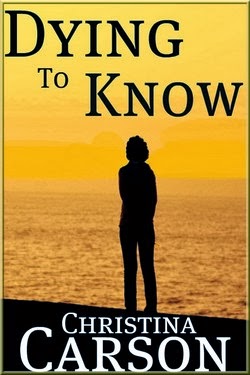
In Dying to Know, Calli Morrow is in the throes of saving her life. So it is rather stunning for her to realize that the way she’s been taught to see the world is somehow involved in this life threatening
 Dying to Know
situation she finds herself in. She says:
“I knew in that moment, we were never meant to surrender our childlike innocence, to trade a world in which we fit like a glove for one that hung on us like ill-fitting hand-me-downs. However, all about us insisted on our membership. And instead of a handshake or a mystical password as entrance into this spurious society, we agreed instead to share a lie, the one that says we’re safe, secure, and fulfilled living this way.”

To her credit she works to undo that conditioning, attempting to save her life on many levels. That is an option for anyone who allows themselves to realize that their beliefs have no basis in fact.

Her Inuit friend, Joe Kuptana, a world-class Sculptor with a different worldview than hers, helped her on her way. He had just told her to engage more deeply with her art as a starting place for change:
“You mean I should engage with my artistic endeavors nonstop?” Calli asked Joe.

“I didn't say anything about artistic endeavors. When you live from your art, you know what’s real and what’s not, what’s true and what’s not.”

 “So that’s why you get on me for endeavors that are art only in name?”

“Yes. The gift you waste is not the lack of turning out pieces to hang on the wall. You waste the experience of life as I learned it from my elders-direct, natural, with no pretense or lies.”

Even our present-day science has run into the wall our conditioning has created, for it too now knows there is no such thing as objectivity unless we separate ourselves from our conditioning and see what’s left.  

Calli said it this way:
As if my normal flaws and limits fell away, I relived my innocence. That age before my vision clouded over like a sooty window letting light neither in nor out, before I accepted that beauty, joy and oneness had opposites.

Novels can take us to the truth in the midst of their fiction. It’s not that the reader necessarily feels what the protagonist does, but that the situation is vivid and trustworthy enough that the reader can chance touching that scene or situation with something other than their mind. It is in such a moment that truth speaks to us all.


Monday, February 24, 2014

Commas Save Lives

By Christina  Carson

Recently I saw a t-shirt advertised in one of those catchall catalogs that come in the mail. Across the top of the shirt it said: Commas save lives. It was followed by two short sentences to prove the point:
Let’s eat Grandmother.
Let’s eat, Grandmother.

 Rules have been around for seeming forever whether they refer to grammar or etiquette, social mores or legality. Almost anyone can make a case for rules. They give us a sense of order and continuity in our day to day lives….to a point. Beyond that, their impact becomes repressive.

Carl Sagan, cosmologist and astronomer, once said, “We make our world significant by the courage of our questions and by the depth of our answers.”

Here then is a two-fold question that begs a serious look: When do rules begin to diminish society and what is the nature of that deterioration? 

Here’s what I've seen over my lifetime. I've noticed a proliferation of rules at every level of society and a waning, almost to the point of extinction, of our willingness or interest in assuming responsibility for our lives as a whole. Do I see those two things as interrelated? I do. We've been willing to trade that sense of freedom and vitality that remains alive in those who take responsibility for their choices and actions for the seeming safety of being taken care of.

I remember a night when Bert and I at a Wednesday night study class at a church in our community raised the question of taking responsibility for one’s life. It practically threw the ranks into rebellion. People were more afraid of that notion than the plague. What pained me was knowing all we forego when we are more focused on assigning and casting blame than on resolving the inherent problem, which is possible when all involved take responsibility for themselves. With commitment to personal responsibility comes the most powerful means of bringing people together and healing the pain of errors that naturally occur. We are safer in the company of people of their word than when we are among rule followers. Yet we didn't get any takers that night. One rarely does.

If you think I’m making an issue out of nothing, here is one more question for you to consider: When was the last time you heard someone, anyone choose to stand before his or her boss, mate or child and take responsibility for their actions rather than assess blame?  We might need the rules of grammar to protect Grandmother, but what’s to become of us as a people if our developmental progress favors being taken care of as opposed to the self-determination, optimism and creativity that accrue to those committed to personal responsibility in their lives.


Apologies to my email community. I believe the multiple copy problem is fixed. 

Tuesday, February 18, 2014

And What Does Your Dance of Life Look Like

by Christina Carson

All Life Dances
With the days acting a tad more like spring, at least in the South, and a reasonable feeling of commitment from the weather that it is not going to freeze our bums off yet again, this seems a fairer question than it might have a month ago. Are you ready? Here goes. What does your dance of life look like? Or better yet, which one of these little tads is you?


I hate to say it but years ago, I was definitely the child on the right, working so blinking hard to do it right, to follow the rules, to please my keepers. As time went on, I started collecting the alleged rewards of that choice, feeling increasingly trapped by the whole affair. Then one day I started pushing the lines further apart until they wouldn't move any further. At that point, I jumped outside of them. At 20 it was quite an adventure. At 50 it was scary as hell. At 68, I now dance down my street after coming in from a run, ipod providing the music, my heart dreaming up the steps. For a while, I feared the neighbors catching sight of me. Now I don’t care. We didn't come here to follow anyone else’s moves, we came here to figure out our own steps and dance for our lives. Go take one more look at that little gal who hasn't agreed to the rules yet. May she carry that joie de la vie through the rest of her life.

With thanks and love to my young friend, Adrienne, who saw this and sent it to her dance-loving friend – so I could embarrass her yet again with my spontaneous high-stepping.   

Keep an eye out. Within the month, I will publish my latest endeavor, a trilogy entitle
Accidents  of  Birth.  Three years in the writing, it’s finally done. If you think you've known someone who knows how to live and  love, wait until you met Miss Imogene Ware.


Thursday, February 13, 2014

My Valentine to You

By Christina Carson

So what is love? This seeming taunt that will not let us be, yet like an impish child running hither and yon, jumping up here and there so we chase like blind fools. When in reality it is more like a faithful hound, which if we just sit quietly, stays as constant company and licks our hand.

All too often, we mistake love for well-met need, but you can always tell, for needs met never leave a residue of awe. Comfort, satisfaction, yes, but not the sense of a heart expanding to the point where the cosmos can enter it without a hint of crowding.

Be love’s champion rather than need’s fool, for love, true love is the only language that the heart speaks, the same language through all cultures, races, ages and space, the most inclusive force the earth knows, modeling it through all its creatures to help its one forgetful child.

Love starts from acceptance; the recognition of another as they are, yet moves on to the awareness that skin is no boundary and mind holds no truths. Standing there, the ocean of you floods in to the ocean that’s me, and then there is only the sea. For love knows one and only one; and in that strange contradiction, lives the secret and the answer for: What is love?

Perhaps the time is here to cease exploring what love is not, and shop the shorter list of what love is.

It is not love that hurts, nor love that frightens us. Our fear is of losing our separateness, our namesake, our address which is not even listed in the directory of the universe, but remains merely an idea in our head. To hold on to that thought that thinks us into existence is to say no to love’s knocking, not now, not this life... as if there were another.

Want to know love more than your next breath, then you will see that beyond the pant, the howl, the wildness of passion, there lives a moment where all stands revealed, and you melt away into exquisite freedom uncaring if you ever return.

 A loving Valentine's Day to you.


Tuesday, February 11, 2014

Alive Inside


Music has always been part of my life. I was a solitary child, and animals and music sustained me. In my early years, I had to provide it for myself through playing the piano, matching the music to my mood. But then came hifi, and music could fill the whole house. Mum and Dad grew up in the Big Band era and when that music came on, Dad would grab Mum and off they’d go like Fred Astaire and Ginger Rodgers. Then there were the trips into Philadelphia for the children’s concerts my mother took me to. I sat as a young kid in this unimaginable concert hall gaping at the surroundings and filling up on the music of the masters.

I have used music all my life as an energy source only, for many years, I didn’t really understand what I was doing. You know how music enlivens you, enhances your mood or experience of the moment. It is indicative of its power that technology moved first in the direction of multiplying sound, not tactile experiences, taste,
scent or visual sensations. Now many people walk around with earphones in place, listening to music not just because they like the tunes. I believe something far more significant than basic likes and dislikes account for this vast change in cultural behavior. I would attribute it to the fact that our lives do not feed us enough anymore; feed us energetically that is. And we are seeing the results in increased use of pharmaceuticals and mind-numbers like TV.

We must have at least as much energy coming into us as is drained away, to sustain life adequately. Yet our energy is being increasingly usurped, in this fretful world, by so much worry, tension, fear. Whether we are aware of the fact or not, we are by nature energetic beings. Energy is what brings us into existence, and energy is what sustains us. If you have any doubts, watch this beautiful video my dear friend, Ralph Miller sent me. See music at work in the capacity of energy source, of bringing someone literally back to life. 


Join me in an exploration of life that truly energizes.

Christina Carson, Author


Saturday, February 1, 2014

Kindly Reviews

By Christina Carson
I suppose you could say this blog grew out of an experience last evening when I spent a few minutes reading a friend’s blog on nasty book reviews, one directed at him in fact. Then I read through the exchange that followed the review on Amazon. All the while, I watched what went on inside of me as I read.

First there was the recognition that still makes me squirm, the memory of the extent of my own righteousness in my youth, for the reviewer was suffering from similar tendencies, which justify in the minds of the righteous all manner of insensitivity. What we don’t get in that moment is that we are responding from fear—fear of not being taken seriously, fear of not being recognized for our seeming greater insight, etcetera, and using the most readily available soul to blame it on. Fear is so integral to all of us, thanks to how we've been conditioned to understand the world, and few people ever tease it out enough to see how deeply it owns them and how unfounded it is.

I think back to my corporate consulting days where we really wanted to show people how possible it is to work together effectively, but were usually called in to end a war or take down conflict. I remember the first time I asked a group of upper management why there was so much fear about the project in question and was promptly told, “We’re not afraid.” I had to bite my tongue not to laugh, so instead I merely asked, “Then what’s all this fighting about?”
Toward the Center
We are creatures of possibilities so vast and so extraordinary that to get stuck on fear like a fly to flypaper is a terrible loss. We can, however, start wherever we find ourselves to take a different run at it. It’s not like if you missed the first 50 lessons of Life 101, it’s too late. All we need do is determine that in the next issue that assails us, we will get to the center of it, for there is only one center—period. That center is called the truth of things. Life lived rightly is not lived linearly. We have Newtonian science to thank for that silly notion. Rather, it’s like we were a big ball and as long as we travel a radial line to the center, we will have lived one moment truly.

There once was a student of meditation that was desperate to meditate more effectively. Every time he came into the presence of his teacher, he would ask the same question until the teacher was weary of seeing him. Having failed to impact the student with all the various explanations he’d offered, one day the teacher merely said, “You know that space between one thought and the next?” The student nodded his head eagerly. “Make it longer.”

So I say to us all, live one true moment. Feel its exquisite peace, its indescribable beauty, its total lack of fear. Then go for another one.

Then listen to Rumi from his poem Zero Circle:

…When we have totally surrendered to that beauty,
We shall be a mighty kindness.

          Most anything said with a tad more kindness will be more instructive, more useful and more effective for everyone, for fear won’t be its motivation and Beauty will be its reward.

Take a step toward possibility and subscribe to this blog.

If you receive this via email and prefer to read it on line, click here.